So, moving on, literally and figuratively. An early morning train ride put me on my way to Berlin, Germany's capital and largest city. I guess it's also pretty historically important.
The train ride was relaxing and I passed the time learning remedial German as Destroyer crooned on repeat in my ear (Kaputt is fantastic). As a result, I can proudly say that I know how to count to 12, ask how much something costs, where something is, and say sorry/excuse me, y'know, the important things.
When I wasn't becoming fluent in another language I noticed, unexpectedly, how much space there actually was between the cities. Germany's population is almost three times that of Canada but it's land mass is smaller than Newfoundland and Labrador. That's a lot of people in a small place by Canadian standards, but I saw more grass than concrete and more wind turbines than buildings on the 5-hour trip (not the high-speed train I thought I'd booked). The same was true for all of my train rides throughout the trip.
I got to my hostel to discover it was attached to the North Korean Embassy, so that was neat. It's probably the closest I'll ever get to North Korea but I only got photos of the gate and refrained from taking pictures of the inner compound, mostly out of fear. The hostel itself was nothing to write home about, but a comfortable place to spend three nights, plus it was right down town and around the corner from the U-Bahn.


I went to eat my lunch in the Tiergarten, which was generously packed by Christiane and even included a tiny salt shaker for a hardboiled egg! Unfortunately I managed to spill the entire contents of said salt shaker on myself whilst using it (not quite sure how), and though I'm not a superstitious person I wasn't going to take any chances being alone in Germany and threw some back over my shoulder. Phew, bad luck avoided. Then I just wandered around Pariserplatz and the surrounding area to see what I could find. Pariserplatz itself is kind of weird. On the one hand, it's got the Brandenburg Gate, which is basically THE symbol of Germany. On the other hand it's houses both the French and American embassies, a museum about the Kennedy's, and a Starbucks. Dichotomy? Maybe.
Brandenburg Gate and Fernsehturm.
Soviet memorial.
Reichstag.
Ampelmannchen pedestrian lights, one of the few remaining symbols of East Germany.
DZ Bank in Pariserplatz. Designed by Gehry.
Brandenburg Gate again.
Hotel Adlon, where Michael Jackson dangled his baby.
The most interesting thing that I found was the Memorial to the Murdered Jews of Europe, which is self-explanatory and consists of rows upon rows 2711 black concrete slabs that take up an entire block. As you walk the rows between them the ground starts to undulate and deepen until the blocks that were ankle-high at the outskirts become towering monoliths in the middle only to shrink again as you make your way out. There's a plethora of interpretations (graves, railcars used as transport for concentration camps), but the one I found most interesting is that it represents the spread of anti-Semitism for the Jewish population. Just as it's easy to ignore one small anti-Semitic law, the blocks on the fringes are small and easily avoided. As more and more laws are passed the blocks become taller and taller until there's no escape. Of course there is no right answer. As I learned on my tour later in the week (mentioned later in this post) the point is for it to be ambiguous. You come out of it thinking about what you've seen/experienced and as you think you're remembering the Holocaust. I passed through twice in my three days there and it's a pretty sobering experience... until you see people climbing on top of the blocks and have to break pace for groups of children playing tag. People disrespecting monuments by way of ignorance gets my ire up, but more on that in a later post.


It's location is interesting for two reasons. First, it's in the heart of Berlin, right around the corner from the Brandenburg Gate and Reichstag. This is intentional: the majority of tourists visit those two sights and have to pass by the memorial to get to them. It's confrontational, but that's the point. Anyone can seek out the history of the Holocaust in Berlin if they want to, but this memorial isn't for those people—it's for those who don't want to think about it. The second has to do with what lies literally 50 m away across the street: the site of Hitler's bunker during WWII.
There's a stark contrast between the two sites. The memorial is huge and obvious. Hitler's bunker is now a parking lot.
Yep.
The bunker is still preserved under there, but it's not open to the public and apparently has no access. It's how the German government wants to remember it. In fact, it's only marked by an unassuming information panel and if you weren't looking for it you probably wouldn't even know it was there.
I kept wandering around to snap some more photos killing time before I was supposed to meet up with other exchange kids to go out for the evening.
Berlin Wall remnants, which I didn't actually clue in to until after my tour on the last day. The two rows of cobblestones in front mark where the Wall stood and runs its course throughout the city.
Missed this by a day
I met up with other Edinburites (Edinburgh-ers?) that night to hit the town, or specifically one club. It was called Kaffee Burger and it was awesome (minus the indoor smoking). We dominated the playlist with requests and had an all around amazing time. Berlin sort of never sleeps so we didn't leave the club until 4 am, which was perfect because that's when the first U-Bahn starts and I could get back to my hostel. Mission accomplished.
I spent about 2.5 hours on day two picking courses for next year, but then managed to get out and see some more sights.
Berlinder Dom.
Art near the National Gallery.
Neue Synagoge.
I didn't have too many items on my to-do list, but the Ramones Museum was one of them. It's the first and only museum of its kind and has about 3000 pieces of memorabilia and odds and ends collected by one super fan. That's awesome. Say what you will about lack of musicianship, their simplicity, blah, blah, blah, the Ramones, in my opinion, are one of the best and most important bands of all time. If I could pick one band to see past or present it'd be them. No contest. Truth be told, they've fallen out of my rotation since high school, but this museum reminded me why I loved them so much in the first place. It was nice to spend time with the memories of Joey, Johnny, Deedee, and Tommy (and Marky, CJ, Richie, and Elvis). To say I geeked out would be an understatement—I took more photos in this museum than anywhere else on the entire trip. Most of them probably aren't too interesting to anyone but me, but I've posted a few I feel might transcend fandom.
An amazing press release.
First album signed by all four original members.
Joey's smashed mic stand from Munich, complete with phonetical opening remarks in German.
Guelph?
Gabba, Gabba, Hey!
The museum also has a wall signed by visiting musicians. I found some familiar names.
Delta Spirit at the top, not Biffy Clyro.
Next I stumbled upon the "Sistine Chapel of Graffiti" known as the Kunsthaus. It's a building and backyard full of alternative and amazing street/metal art and graffiti. Unfortunately my camera died, but I managed to snap a few shots beforehand. Word has it that the owners are at risk of being evicted in favour of a new condo development, so see it while you can.
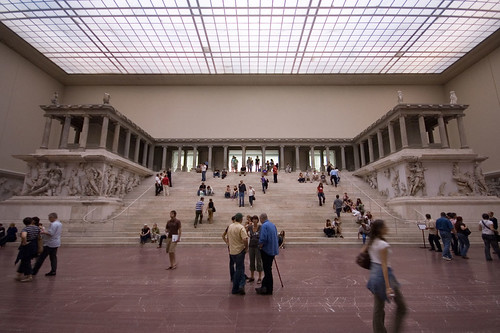
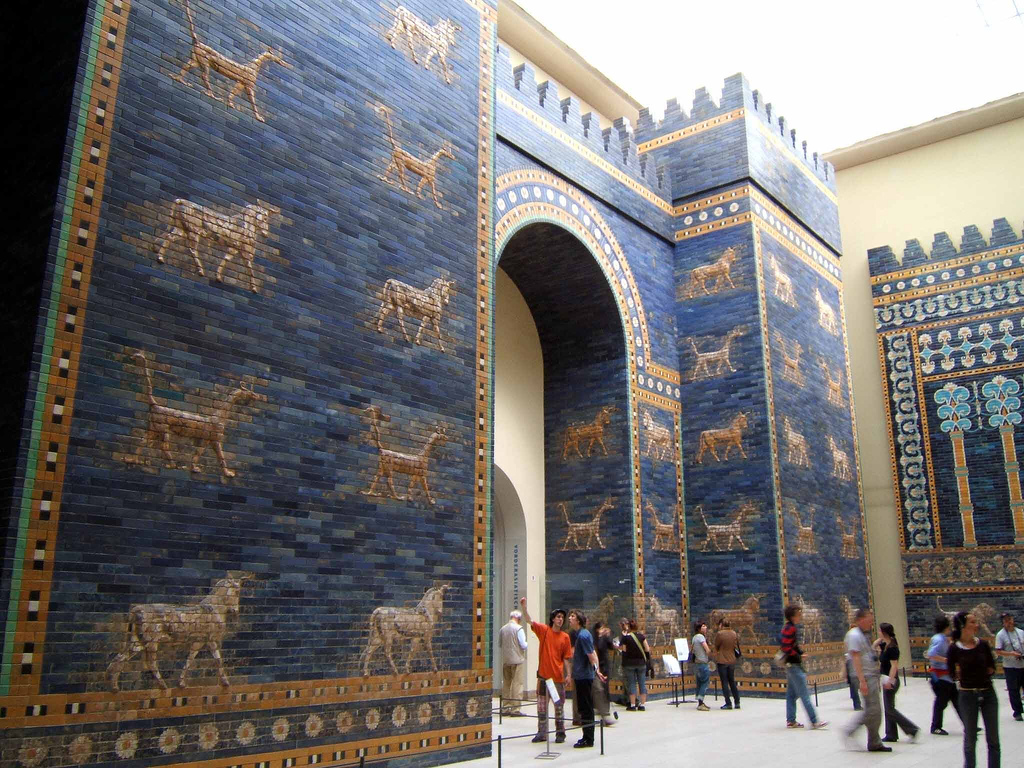
Afterwards I went to the Pergamon Museum which houses some neat things such as the Pergamon Alter and the Ishtar Gate. It was packed and not free even though the guidebook said it was, but enjoyable and informative nonetheless. Again, camera was dead so these are from the internet.
Pergamon Altar.
Ishtar Gate.
My last day was when I finally got around do doing a walking tour of the city. It was a little odd because I had seen almost everything that was going to be covered, but I knew I would get some commentary and insight that I never would've discovered on my own. For instance, do you know why it's called Pariserplatz? Well, when Napoleon was doing his thing across Europe, he stole the statue that now sits on top of the Brandenburg Gate. The Germans eventually defeated him, took the statue back, renamed it Victoria (for victory), and named the square so as to memorialize the victory. Pariserplatz = victory over Paris. Best part? The statue is pointing at the French Embassy in the square.
Here are more photos with descriptions beneath:
Former Nazi air command building, mysteriously untouched during the war (some theorize the Soviets knew they could use it when they took Berlin). Became the Ministry of Ministries during the GDR and was the site of a major protest with civilian casualties that became the catalyst for the building of the Berlin Wall. Now it's a tax office.
Pro-socialist mural on the building painted during the GDR era.
I think Larry David accidentally participating in a pro-socialist parade would make for a great episode of Curb.
Berlin Wall. Pretty grim and not as big as I expected.
French Cathedral. It's the identical twin to the German Cathedral that it faces and was built to encourage French Hugenots to come to Berlin. Both were destroyed during the war, but later rebuilt. The statues are the only remaining original parts because Hitler hid them and many others from around Berlin during wartime.
Former library of Humbolt University and where the first Nazi book burning took place.
Book Burning Memorial. It's a series of empty bookshelves underground. This was taken at night when it was easier to see inside.
Altes Museum.
Scars from the war on the Berliner Dom.
Simply put, the tour was profound. I learned an incredible amount and gained a whole new appreciation for the city in three hours. Cliche alert, but it really brought history to life.
Then it was off to the East Side Gallery, the largest remaining stretch of the wall and the world's largest outdoor art exhibit. It's a memorial to freedom and began in 1990 after the wall fell. There are just over 100 paintings and, luckily for me, they'd almost all undergone recent refurbishment to get rid of graffiti, erosion, and vandalism.
Not on the wall, but cool nonetheless.
From there I briefly explored the Kreuzberg area en route to the Jewish Museum. Kreuzberg is where the punks hang out and I was there to check out a record store recommended by the staff at the Ramones museum. I was dressed in far too much colour (grey) and had too little holes in my face and ink in my arms to really fit it, but I did manage to walk away with a Japanese import of the Blitzkreig Bop 7" on translucent red vinyl... by the Ramones. I had hoped to find a local Berlin band, but they all sung in English (as did most "foreign" bands I came upon on the trip) and based on the day before, I felt a Ramones purchase was fitting.
It was already getting late when I arrived at the Jewish Museum and I was wiped from a whole day on my feet, so I didn't give it nearly enough time as it deserved. I will say the building was just as interesting as the exhibition. Look it up if you can.
Jewish Museum.
I passed through Checkpoint Charlie on my way for food, but the entire thing, save the location, is fake. Tourists kept asking to see the sign, so they just put up a new one.
I ended up what I think may have been vegan currywurst (are you supposed to cook a sausage by deep-frying?) and it wasn't very good so I had to go and get a doner to fill the void. I went and ate it in Alexanderplatz under the lights of the TV Tower and reflected on my time in Berlin. I realize I only got an impression of the city, but man, what a city! At once fascinating, overwhelming, confusing, vivacious, and above all addictive. As my guide pointed out, this is a city where people from one side were killing people from the other little more than twenty years ago. To see where it is right now is to see a city, and effectively a country, transformed. I didn't want to leave, but I know I'll be back.